Published by the AAAT Compliance Team · Access All Areas Training (RTO 52312). Last reviewed: 19 October 2026 · Reviewed against current regulator guidance.
If you run a food business anywhere in Australia — or you've been told you need to "become the Food Safety Supervisor" — this guide explains exactly what that means, who the requirement applies to, how it differs from basic food handler training, and the special rules that apply in New South Wales. Every requirement here traces to Food Standards Australia New Zealand (FSANZ) or the relevant state food authority.
Food Handler vs Food Safety Supervisor: two different things
The most common confusion in food safety training is between these two certifications — and getting the wrong one wastes money and leaves the business non-compliant.
Food Handler training covers the basics every person working with food needs: hygiene practices, identifying food hazards, and safe handling. It's built on the nationally recognised unit SITXFSA005 Use Hygienic Practices for Food Safety. If you make coffees, plate meals, stock shelves with unpackaged food, or wash dishes in a commercial kitchen, this is your certificate.
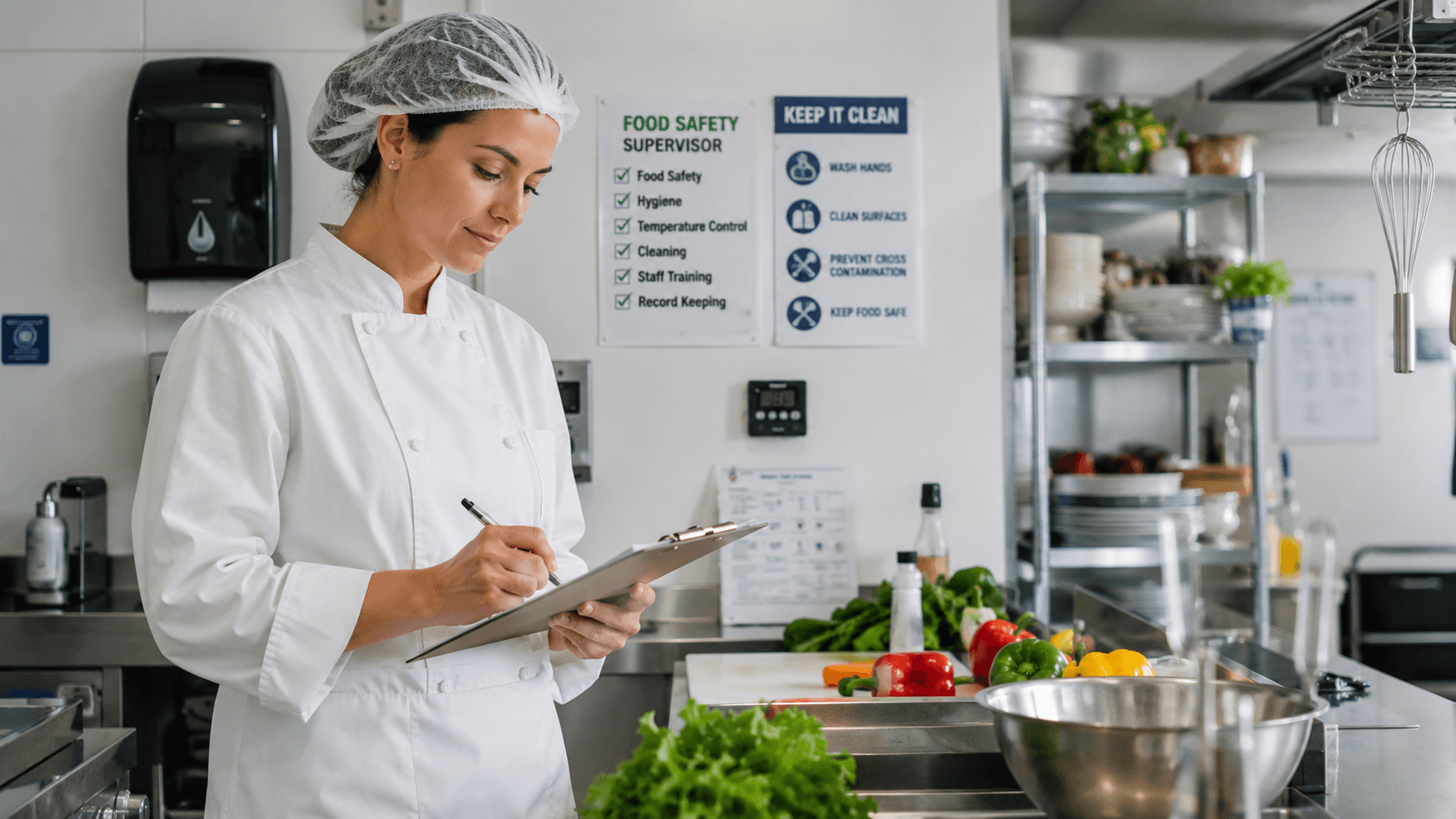
Food Safety Supervisor (FSS) certification is a step above. An FSS is the trained person a food business appoints to oversee food safety on site — someone with the authority and knowledge to supervise others, recognise risks, and act on them. FSS certification requires two units: SITXFSA005, the food handler unit, plus SITXFSA006 Participate in Safe Food Handling Practices.
The practical rule of thumb: staff need Food Handler training; the business needs at least one certified Food Safety Supervisor. Many owners and managers complete the FSS course themselves.
Why this became mandatory: Standard 3.2.2A
On 8 December 2023, food safety Standard 3.2.2A commenced under the Australia New Zealand Food Standards Code. It introduced formal food safety management tools for food service and retail businesses, including:
- Food handler training — people who handle unpackaged, potentially hazardous food must be trained before or as they start that work
- A certified Food Safety Supervisor — affected businesses must appoint an FSS who is reasonably available to supervise food handling
- Evidence and record-keeping obligations — higher-risk businesses must be able to substantiate how they manage key food safety controls
Which tools apply depends on the business's category under the Standard — broadly, higher-risk businesses handling unpackaged, ready-to-eat, potentially hazardous food carry the fullest obligations. Cafés, restaurants, takeaways, caterers, pubs serving food, and many retail food businesses are captured. If you're unsure of your category, your local council or state food authority can confirm it — and confirming it is itself part of doing this properly.
The obligation isn't one-off. FSS coverage has to be maintained: when your certified supervisor leaves, the business needs a new one, and new food handlers need training as they join.
The NSW rules: approved providers only
New South Wales runs the strictest FSS regime in the country, administered by the NSW Food Authority — and this is where many businesses get caught out.
In NSW, a Food Safety Supervisor certificate must be obtained through a NSW Food Authority approved training provider. Completing the two national units with a provider that isn't on the Authority's approved list does not satisfy the NSW requirement — the units alone aren't enough; the certificate has to come through the approved channel. The Authority also requires FSS certification to be renewed through recertification rather than held indefinitely.
Access All Areas Training is a NSW Food Authority approved provider, approved provider number 25813. You can verify this on the Authority's published list of approved providers, and we'd encourage any business to run that check on whichever provider they choose. A certificate that doesn't satisfy the regulator is worse than no certificate — it's money spent while remaining non-compliant.
Outside NSW, the FSS requirement flows from Standard 3.2.2A itself, delivered through nationally registered training organisations. The delivery rules differ by state; the underlying units, SITXFSA005 and SITXFSA006, are the same.
Who in your business needs what
- Kitchen hands, baristas, wait staff plating food, deli staff — Food Handler training (SITXFSA005)
- The appointed supervisor, often the owner, manager or head chef — Food Safety Supervisor certification (SITXFSA005 + SITXFSA006)
- A NSW food business — FSS certified through a NSW Food Authority approved provider
- New starters handling unpackaged food — food handler training before or as they begin that work
Two practical notes for owners. First, appoint more than one FSS if you can — coverage breaks the day your only certified supervisor resigns, and inspectors ask who the supervisor is today, not who it was last month. Second, keep the certificates on file and producible: being trained and being able to show you're trained are both part of the obligation.
How to get certified with AAAT
Food Handler Certificate — $59. Fully online, self-paced, with your Statement of Attainment for SITXFSA005 issued the same day you complete. Valid for work in every Australian state and territory.
Food Safety Supervisor — from $138, by state. Both required units (SITXFSA005 + SITXFSA006), fully online and self-paced, same-day certificate on completion. For NSW businesses, AAAT's approval as NSW Food Authority provider 25813 means your certification satisfies the NSW regime — the state where an unapproved certificate is most costly.
Both courses are delivered by Access All Areas Training, RTO 52312 — nationally registered since 2010, with more than 200,000 students trained and a 4.7-star rating from over 1,900 Google reviews.
Start here — state-specific Food Safety Supervisor Skill Set courses:
- New South Wales (NSW Food Authority-approved, NSW certificate issued): accessallareastraining.com.au/courses/new-south-wales/food-safety-training/food-safety-supervisor-skill-set-online
- Victoria: accessallareastraining.com.au/courses/victoria/food-safety-training/food-safety-supervisor-skill-set-online
- Queensland: accessallareastraining.com.au/courses/queensland/food-safety-training/food-safety-supervisor-skill-set-online
- Western Australia: accessallareastraining.com.au/courses/western-australia/food-safety-training/food-safety-supervisor-skill-set-online
- NSW re-certification, for supervisors renewing: accessallareastraining.com.au/courses/new-south-wales/food-safety-training/food-safety-supervisor-recertification-online
Related guides: Does a food safety certificate expire? · Food handler vs Food Safety Supervisor: which do you need? · Food Safety Training Hub.
Frequently asked questions
Can the owner be the Food Safety Supervisor? Yes — and in small businesses it's the most common arrangement. The owner or manager completes FSS certification and is appointed as the supervisor.
Does one FSS cover multiple sites? The supervisor must be reasonably available to the food handling operation they supervise. Multi-site businesses generally need FSS coverage arranged per premises — if you operate several locations, confirm your arrangement with your local food authority.
Do certificates from other states work in NSW? For the FSS requirement, NSW recognises certification through its approved-provider channel. If your FSS certificate wasn't issued through a NSW Food Authority approved provider, check with the Authority before relying on it — and when in doubt, recertify through an approved provider.
How long does the training take? Both courses are self-paced and online. Most students complete the Food Handler course in a single sitting; the FSS course takes longer as it covers two units. Certificates issue the same day you successfully complete.
Is this the same as a "food safety certificate"? "Food safety certificate" is the everyday term people use for both. When a job ad asks for a food safety certificate, it usually means Food Handler training. When a council, auditor, or the NSW Food Authority is asking, they usually mean the Food Safety Supervisor requirement. If you're not sure which one you're being asked for, ask who's asking, and match the certificate to the obligation.
Sources
- Food Standards Australia New Zealand — Standard 3.2.2A Food Safety Management Tools (commenced 8 December 2023), foodstandards.gov.au
- NSW Food Authority — Food Safety Supervisor requirements and approved training providers, foodauthority.nsw.gov.au
- Australian Government — training.gov.au: SITXFSA005, SITXFSA006, SITSS00069
Learn more: our Food Safety Training Hub covers Food Handler vs FSS in depth, Standard 3.2.2A explained, and requirements for all eight states and territories. Venue owners can see our employer page for training whole teams.
This guide is general information, current at publication, and is not a substitute for confirming requirements with your local council or state food authority. AAAT is a provider of the training discussed — an interest we disclose.